 Valley of the Kings Tour
The Colossi of Memnon: Amenhotep III's Twin Statues
The Colossi of Memnon are the two giant seated statues of Amenhotep III on the Luxor West Bank, and they are a common stop on West Bank tours. This guide covers what they are, how big they are, why one of them was famous for singing at dawn, and what the excavation behind them has uncovered. It also explains the practical side: entry is free, the statues stand right beside the road, and most tours stop for a short photo break. By the end you will know how much time they deserve on your itinerary and which nearby sites pair well with them. The bookable tours are compared on Luxor Valley of the Kings tours.
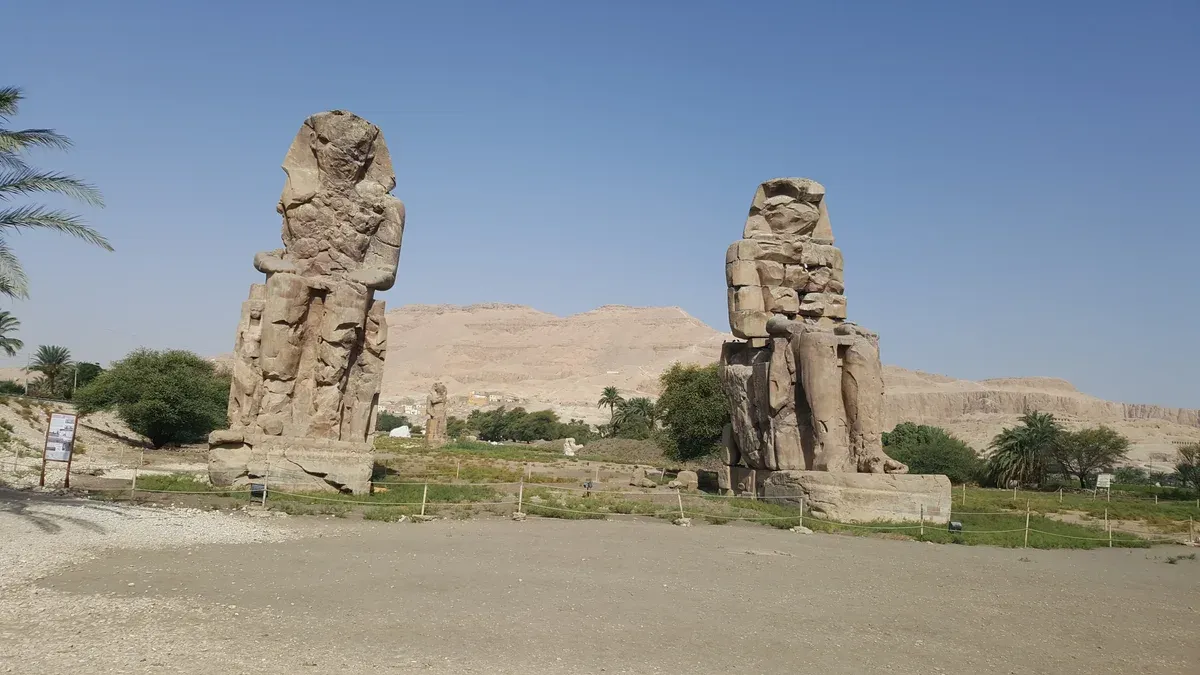
The two Colossi of Memnon with the hills of the West Bank behind them. Photo: Ovedc, CC BY-SA 4.0, via Wikimedia Commons
Quick answer What the Colossi of Memnon are
The Colossi of Memnon are two seated statues of Pharaoh Amenhotep III, about 18 metres tall including their bases and about 720 tons each, standing beside the road on the Luxor West Bank. Entry is free and you view them from the roadside.
Key takeaways
- Entry costs nothing, so the stop fits any budget before a Valley of the Kings tour.
- They guarded a huge mortuary temple, now being excavated by the Amenhotep III Temple Conservation Project.
- The northern statue sang at dawn after an earthquake in 27 BC, drawing Roman visitors whose graffiti survives.
- The tours that state a time stop for 10 to 30 minutes, as the tour stop table shows.
Two Statues of Amenhotep III
The Colossi of Memnon are the surviving front line of the mortuary temple of Amenhotep III, a king of the 18th Dynasty.
Size and Stone
Each colossus stands about 18 metres high including its base and weighs about 720 tons. The king sits with his hands flat on his knees, facing east-southeast toward the Nile. Carved on the throne beside his legs are his wife Tiye and his mother Mutemwiya, and the side panels show the Nile god Hapi. The two statues stand about 15 metres apart.
The material is the striking part. The quartzite blocks were quarried at el-Gabal el-Ahmar near Cairo and hauled 675 kilometres overland to Thebes. The southern colossus is a single piece of stone. The northern one tells a different story: its lower half is cracked, and above the waist it is built from five tiers of a different sandstone, added during a later reconstruction after the statue broke. A lithograph by David Roberts from the 1840s shows the Colossi of Memnon surrounded by flood water.
Why They Are Called Memnon
The name is Greek, not Egyptian. Greek visitors linked the northern statue to Memnon, a mythical king of Ethiopia and son of Eos, goddess of the dawn. That link is why the whole Theban necropolis later became known as the Memnonium. Local Arab tradition gave the statues their own names, Shama and Tama, and the temple site behind them is known in Arabic today as Kom el-Hettan.
If you are planning the wider West Bank, the colossi are one stop on a West Bank circuit with Temple of Hatshepsut and Medinet Habu. The Valley of the Kings map shows how the sites line up along that route.
Sources: Wikipedia, Colossi of Memnon
The Statue That Sang
After the 27 BC earthquake, the northern statue was reputed to sing.
The Earthquake and the Sound
An earthquake in 27 BC broke the northern colossus. From that damage came the legend. The damaged statue was reputed to sing, always within an hour or two of sunrise, and the sound drew visitors. The Greek geographer Strabo reported hearing the sound himself in 20 BC. Pausanias compared it to the snap of a breaking lyre string. The last reliable record of the sound dates from 196 AD.
The likely cause is natural rather than divine. According to Wikipedia's account, rising temperature evaporated dew inside the porous stone.
The Graffiti of the Visitors
The pilgrims left their mark. The statues carry 107 Roman-era inscriptions in Greek and Latin, dated between 20 and 250 AD. Of these, 61 are in Greek, 45 in Latin and one is bilingual. Among them are the poems of Julia Balbilla, who recorded visits during November 130 AD by a party that included the Emperor Hadrian and his wife Vibia Sabina.
The inscriptions were first studied in detail by Jean-Antoine Letronne, who catalogued them in 1848. The Emperor Septimius Severus visited the statue but is not recorded as hearing the sound, and local tradition dates the repair to about 199 AD. The last reliable mention of the sound dates from 196 AD. The reconstruction with tiers of sandstone above the waist is what you see on the northern colossus now. The two statues of Amenhotep III section covers the stone itself.
Sources: Wikipedia, Colossi of Memnon
The COLOSSI of MEMNON
A short film on the two giant statues of Amenhotep III and their history. Third-party video by World of Antiquity. This site did not shoot it and has no relationship with the creator.
The Temple Behind Them
Behind the colossi lay the mortuary temple of Amenhotep III, and excavation there is still going on.
What the Excavation Has Found
The mortuary temple of Amenhotep III was designed by the architect Amenhotep son of Hapu. The Armenian Institute of Seismology dated a destructive earthquake at the temple to about 1200 BC, an event that left only the two colossi standing and buried many statues where they fell. The main axis was built on a natural mound above the floodplain, and the excavation found a previously unknown branch of the Nile that once ran past the colossi.
Since 1998 the Colossi of Memnon and Amenhotep III Temple Conservation Project has been directed by Hourig Sourouzian, working under the Egyptian ministry and the German Archaeological Institute in Cairo. Sourouzian's team established that the complex had three pylons, each fronted by colossal statues, and a peristyle court with columns at the far end. The dig revealed hundreds of statues, including many of the lion-headed goddess Sekhmet, sphinxes, a white hippopotamus and scarab beetles.
The Re-Erected Statues
The project is not only digging, it is rebuilding. According to Wikipedia's account, four statues have been re-erected at the site so far, eight more await re-erection, and about 200 statues or fragments are in the Luxor Museum.
The colossi and their temple are one stop on the West Bank circuit with Temple of Hatshepsut, Medinet Habu and the tombs. Compare the full range of Valley of the Kings tours from Luxor to see which itineraries stop here. For the tombs themselves, start with the guide to Valley of the Kings tickets.
Stopping at the Colossi
A visit costs nothing and takes as long as your schedule allows. Here is what the bookable tours actually offer at the site.
How Long Tours Stop
The figures below come from the tour listings themselves, which state how long each itinerary allows at the Colossi of Memnon. Few listings state a time at the Colossi, and the difference between 10 and 30 minutes is the difference between a look and a walk around both figures. For the full side-by-side comparison of prices and inclusions, see the comparison table on the homepage.
Note what the stop does and does not include. The statues are free to view from the roadside. Entry tickets to the Valley of the Kings or the special tombs are a separate matter and some tours exclude them entirely, as the Tutankhamun's tomb and tomb of Seti I guides explain.
| Tour | Time at the Colossi | Price |
|---|---|---|
| Hurghada Day Trip with Tut's Tomb | 30 minutes | $93 |
| Balloon Ride and Full-Day Sights | 10 minutes (optional stop) | $160 |
| Private Both Banks with Tut's Tomb | 30 minutes | $80 |
Free Entry, Light and Crowds
Wikivoyage lists the Colossi of Memnon with no admission charge, viewed from the roadside. You look up at about 18 metres of quartzite from the road.
The light matters. The statues face east, so the morning sun lights their fronts and the carvings of Tiye and Mutemwiya read clearly. By early afternoon the sun is behind them and photos become silhouettes.
Sources: Wikivoyage, Luxor West Bank
Reading the Thrones and the Stone
The details on the thrones and the story of the stone repay a closer look.
Who Sits Beside the King
Both statues show Amenhotep III seated with his hands flat on his knees, facing east-southeast toward the Nile. Carved on the throne beside his legs are two figures: his wife Tiye and his mother Mutemwiya. The side panels carry reliefs of Hapi, the Nile god, who ties the plants of Upper and Lower Egypt together in a symbol of union. The two statues stand about 15 metres apart, so you can circle both in a few minutes and compare them at close range.
The pair also differ in build, which is easy to spot once you know why. The southern colossus was carved from a single piece of stone. The northern one has a cracked lower half and five tiers of lighter sandstone above the waist, the result of its later repair.
Stone Hauled 675 Kilometres
The quartzite came from el-Gabal el-Ahmar, a quarry near Cairo, and was hauled about 675 kilometres overland to Thebes. That feat, for blocks forming statues about 18 metres tall with their bases and around 720 tons each, still has no fully agreed explanation. For comparison, the fallen colossus at the Ramesseum, Ramesses II's temple nearby, weighed an estimated 1,000 tonnes.
A lithograph by David Roberts from the 1840s shows the two Memnon statues standing in flood water, a reminder of how close the old river channel once ran. For planning your own visit, the private West Bank half day lists the Colossi alongside the Valley of the Kings and Hatshepsut's temple at $40, with more context in the guide to a Valley of the Kings tour.
The Colossi on Tour Itineraries
Almost every West Bank itinerary treats the statues as a short stop, but the stop sits inside very different days.
Half Days and Full Days Compared
The statues appear on tours ranging from a 5-hour Luxor morning to a 15-17 hour day from Hurghada. The same free stop gets packaged with different tickets, transport and lunch arrangements on each listing.
| Tour | Duration | Price | Departs from |
|---|---|---|---|
| West Bank Half Day with Lunch | 5 hours | $23 | Luxor |
| Private West Bank, Kings and Queens | 8 hours | $89.24 | Luxor |
| Balloon Ride and Full-Day Sights | 9 hours | $160 | Luxor |
| Hurghada Small Group, Entry Options | 15-16 hours | $45 | Hurghada |
Choosing Where the Stop Fits
If the statues are your main interest, note that they carry no admission charge, so the fee add-ons on cheaper options buy you nothing at this stop. A half day such as the West Bank half day with lunch covers the Colossi plus the Valley of the Kings and Hatshepsut Temple in 5 hours from Luxor. If you want the full mortuary landscape, the private West Bank day covering kings and queens also includes Medinet Habu and Deir el-Medina, with entry fees to five sites included in its 8 hours.
Both tours are compared in full on the homepage listings for Valley of the Kings tours.
Colossi of Memnon FAQ
Why are the Colossi of Memnon important?
They are the only standing remains of the vast mortuary temple of Amenhotep III, each about 18 metres tall and about 720 tons, and the temple behind them has been excavated since 1998. The excavation behind them is still re-erecting statues today. See the section on the temple behind them.
Is the Colossi of Memnon worth visiting?
Yes, because entry is free, the site sits directly on the West Bank road, and the stop costs only 10 to 30 minutes of an itinerary. The stop times on the tours show how little time it takes, and the Valley of the Kings map shows how conveniently they sit on the circuit.
Do the Colossi of Memnon still sing?
No. The northern statue was reputed to sing within an hour or two of sunrise after it cracked in the 27 BC earthquake, with Strabo reporting the sound in 20 BC and the last reliable mention in 196 AD. The statue was repaired under Septimius Severus around 199 AD. Read the full story of the singing statue.
What happened to the Colossi of Memnon?
The temple behind them was destroyed by an earthquake around 1200 BC, leaving the two colossi standing. The 27 BC earthquake then broke the northern statue, which was reputed to sing at dawn and was later rebuilt with sandstone tiers, a repair dated by local tradition to about 199 AD. Today a conservation project has re-erected four statues at the site. Details in the temple section.
How much does it cost to see the Colossi of Memnon?
Nothing. Wikivoyage lists the site with no admission, and you view the statues from the roadside, so there is no entry charge. Budget goes instead to the ticketed sites nearby, which the guide to Valley of the Kings tickets breaks down.