 Valley of the Kings Tour
Tutankhamun's Tomb (KV62): What You See Inside
Tutankhamun's tomb, known as KV62, is a burial in the Valley of the Kings that escaped the robberies that stripped most royal tombs. The mummy still lies inside, in a climate-controlled glass case. This page covers the discovery by Howard Carter in 1922, the four chambers and the wall paintings you can see today, why the tomb is so small, and where the 5,398 burial objects ended up. It also explains the separate ticket, the replica burial chamber near Carter's House, and which Valley of the Kings tours actually include entry to KV62, so you know what you are paying for before you go down the entrance stair.
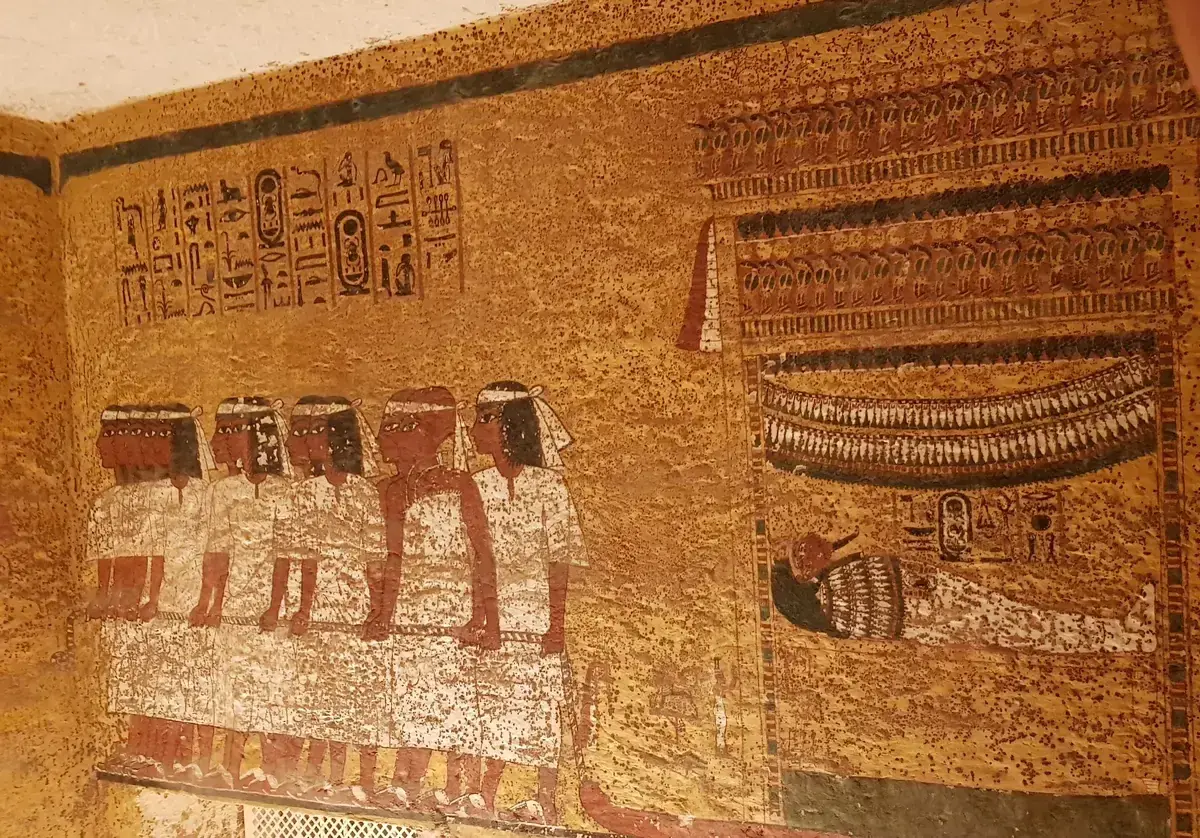
The painted procession on the burial chamber wall of Tutankhamun's tomb, KV62. Photo: Romagy, CC BY-SA 4.0, via Wikimedia Commons
Quick answer KV62 in brief
Tutankhamun's tomb KV62 sits in the Valley of the Kings, and the king's mummy is still inside it in a glass case. Visiting needs a separate ticket on top of the main valley ticket, and you see a small, plain tomb with paintings in one chamber only. The gold treasures went to the Grand Egyptian Museum near Cairo.
Key takeaways
- The Hurghada day trip with Tutankhamun's tomb at $93 includes entry tickets and KV62, with lunch and pickup from Hurghada resorts.
- The private both-banks day with Tut's tomb at $80 lists Tutankhamun's tomb among three valley tombs, with entry fees as a booking option.
- Entry rules, prices and covered tombs are on the Valley of the Kings tickets page.
- For how the tours compare on price, duration and what they include, see the comparison of Valley of the Kings tours on the homepage.
How Carter Found the Tomb
KV62 escaped the robberies that stripped most royal tombs, and the story of its discovery explains why.
The Search and the Steps
Howard Carter dug for his patron Lord Carnarvon in a part of the valley floor that the earlier excavator Theodore Davis had left alone, because Davis believed no tomb had been cut into the bedrock there. Davis's teams had instead found KV54, a pit holding objects with Tutankhamun's name, and KV58, a small tomb with chariot harness fittings.
On 4 November 1922 a worker uncovered steps under the debris. The entrance had been buried under flood material, workers' huts built for the tomb of Horemheb, and spoil from the later KV9, which is also why it escaped the robberies that stripped most royal tombs in the late Twentieth and Twenty-first Dynasties. The tomb had in fact been robbed twice soon after the burial, and officials had repaired it and filled the corridor with limestone chips after the first break-in.
The Sealed Doors
Carter breached the doorway on 26 November 1922. The objects were so many that the antechamber alone held 600 to 700 pieces and the annexe more than 2,000. The sealed burial chamber was opened on 16 February 1923.
The work did not run smoothly. Carter and his team fought the Egyptian government over press access, stopped work in protest in February 1924 and only resumed after the dispute ended in January 1925. The coffins and the mummy were opened and removed in 1925, and clearance of the tomb itself finished in November 1930. The full clearing job took ten seasons and closed in February 1932. Lord Carnarvon never saw the end of it, since he died on 5 April 1923, which fed the popular story of a curse of the pharaohs.
Why the Tomb Is So Small
KV62 has four chambers plus an entrance corridor, which makes it far smaller than most royal tombs in the valley. According to the standard account it probably began as a non-royal tomb, possibly meant for Ay, and was adapted after Tutankhamun died at around 18 to 19 years old, and the burial chamber and treasury may have been added at that point. The burial chamber lies north of the antechamber, so the tomb bends to the right, while most Eighteenth Dynasty royal tombs bend to the left.
The king had reigned from about 1332 to 1323 BC, and one Wikipedia account gives about 1334 to 1325 BC instead. His goods barely fit in the space, so the Egyptologist Joyce Tyldesley argues that larger royal tombs may have held similar sets of objects arranged far more spaciously. The tomb sits on the west side of the main path, cut into the limestone bedrock of the valley floor beneath a low foothill.
What You See Inside KV62 Today
Visitors today walk down a short stair and corridor into four small rooms. There is little decoration, and the main draw is the burial chamber with its sarcophagus and wall paintings.
The Four Chambers
The table below sets the four chambers of KV62 side by side, with what Carter found in each and what a visitor sees at the site today. The measurements come from the published tomb description. All chambers stand between 2.3 and 3.6 metres high, and the floors of the annexe, burial chamber and treasury sit about 0.9 metres below the antechamber floor.
The entrance stair originally had sixteen steps, of which the lowest six were cut away during the burial to move the largest furniture through, rebuilt, then removed again by the excavators. The corridor you walk down is 8 metres long and 1.7 metres wide.
| Chamber | What it held | What you see now |
|---|---|---|
| Antechamber, 7.9 by 3.6 metres | 600 to 700 objects packed tightly, part of the 5,398 total including 413 shabtis | The mummy of Tutankhamun in a climate-controlled glass case, in place since 2007 |
| Annexe, 4.4 by 2.6 metres | More than 2,000 objects | A small room of 4.4 by 2.6 metres |
| Burial chamber, 4 by 6.4 metres | The innermost solid gold coffin, set inside two gilded wooden coffins | The quartzite sarcophagus with its red granite lid painted yellow, carved with Isis, Nephthys, Neith and Serqet, and the only wall paintings in the tomb |
| Treasury, 4.8 by 3.8 metres | Further burial goods | A small chamber of 4.8 by 3.8 metres |
The Paintings and the Mummy
The only wall decoration in KV62 is in the burial chamber, painted on a yellow background with nothing carved in relief. On the north wall Ay performs the Opening of the Mouth on Tutankhamun's mummy, a scene that legitimised Ay as heir, before the king greets Nut and Osiris. The east wall shows the funeral procession, a scene found in no other royal tomb, and the west wall shows twelve baboons from the first section of the Amduat. The south wall showed the king with Hathor, Anubis and Isis, but Carter destroyed the figure of Isis when he demolished the partition that carried part of the painting.
The innermost coffin is made from 110.4 kg of solid gold, but it has left the tomb, along with the funerary mask that weighs about 11 kg. The mummy itself stayed, with 143 items found inside its wrappings, including sandals, amulets and two daggers. A 2005 CT scan found a compound fracture of the left leg that had not begun to heal at death. On busy days up to 1,000 visitors pass through. No papyrus texts were found among the burial goods, which disappointed Egyptologists hoping for records of the Amarna Period.
Conservation and the Hidden Chamber Story
The tomb has needed real care. On New Year's Day 1991 a rainstorm flooded KV62 through a fault in the burial chamber ceiling and left about 7 centimetres of standing water on the floor. The Getty Conservation Institute and the Egyptian ministry then carried out a roughly decade-long conservation that finished in 2019, adding a ventilation system to control dust, carbon dioxide and humidity, plus new barriers, walkways and platforms.
The brown spots on the paintings turned out to be dead microbes that have not changed since photographs taken in the 1920s. They grew into the paint layer and cannot be removed without damage. In 2015 Nicholas Reeves argued from Factum Arte scans that two chambers hid behind the plaster partitions, but radar surveys in 2016 and 2018 found no voids, though a microgravity study published claims hidden chambers are still possible.
Sources: Wikipedia, KV62, Archaeology.org on the 2019 restoration
Tutankhamun Tomb Virtual Tour in Valley of the Kings Luxor Egypt.
A virtual walk through the tomb of Tutankhamun in the Valley of the Kings. Third-party video by From Holiday. This site did not shoot it and has no relationship with the creator.
Where the Treasures Are Now
Almost nothing you have seen in photographs of the golden mask is still in Luxor. The whole collection moved to Cairo.
The Grand Egyptian Museum in Giza
The Grand Egyptian Museum in Giza officially opened on 1 November. It displays the 5,398 Tutankhamun objects across two halls covering 7,000 square metres, the first time the whole collection has been shown together. The building sits about 2 km from the Giza pyramid complex on a site of 500,000 square metres.
Until the move, the collection had been held by the Egyptian Museum in Tahrir Square. The practical consequence for a visitor in Luxor is simple: the treasures of Tutankhamun are in Giza near Cairo, not in Luxor, and only the tomb itself and the mummy are in the Valley of the Kings. If you came to Luxor expecting to see the mask, plan a separate visit to Giza, and use the Valley of the Kings map to see what the other open tombs around KV62 hold instead.
Sources: Wikipedia, Grand Egyptian Museum
Is the Extra Ticket Worth It
An honest answer first, then the ways to buy the entry, including tours that bundle it.
The Honest Answer
The main Valley of the Kings ticket covers three ordinary tombs, and KV62 is not one of them. It needs its own separate ticket, so budget for two tickets if the boy king is the reason you came.
What you get is the real burial chamber with its paintings, the sarcophagus lid, and the mummy in its glass case. What you do not get is any gold. Visitors who expect the mask will not find it, because the tomb is small and plain. If you have read about the tomb and want to stand where Carter stood, it is worth it. If you only want to see treasure, save the money and put it toward the Grand Egyptian Museum in Giza.
The Replica Near Carter's House
There is a second way to see the burial chamber. Factum Arte scanned it in 2009, after the Society of Friends of the Royal Tombs of Egypt first suggested a replica in 1988. The facsimile of the burial chamber was unveiled on 4 November 2012, the 90th anniversary of the discovery, and opened to the public on 30 April 2014.
The replica stands in the Valley of the Kings next to Howard Carter's House, in an underground space designed by the architect Tarek Waly. The replica walls are 3.60 metres high, CNC-routed in sections of 1.5 metres and finished with printed ink-jet skins and acrylic gesso, so the paintings appear at full scale. Entry to Carter's House next door is listed at LE80 on Wikivoyage.
Tours That Include or Offer KV62
Most Valley of the Kings tours do not list Tutankhamun's tomb, so check before booking. Three do, and they differ in what the price actually buys. The table figures come from the tour listings, and the full breakdown sits in the comparison table on the homepage.
| Tour | Price | What the Tutankhamun entry includes |
|---|---|---|
| Hurghada day trip with Tut's tomb | $93 | Entry tickets and entry to the Tutankhamun tomb included, plus lunch and hotel pickup in Hurghada |
| Private both-banks day with Tut's tomb | $80 | The visit names Tutankhamun's tomb among three valley tombs, but entry fees are only included if you pick that option at booking |
| Hurghada small group day | $45 | The Tutankhamun tomb is sold as an optional extra, and the listing adds $11.23 in charges to the $45 base price without saying what they cover |
Sources: Factum Foundation, Wikivoyage, Luxor West Bank.
Questions About Tutankhamun's Tomb
Can you visit the tomb of Tutankhamun?
Yes. KV62 is open to visitors in the Valley of the Kings on the west side of the main path, with the mummy in the antechamber and the painted burial chamber open. Entry needs a separate ticket on top of the valley ticket, and the details are on the Valley of the Kings tickets page.
Why is the tomb of Tutankhamun so famous?
Because it escaped the robberies that stripped most royal tombs and held about 5,398 objects. The discovery made Carter famous, and the collection now fills two halls of the Grand Egyptian Museum in Giza.
What happened to Howard Carter, the man who found the tomb?
Clearing the tomb took ten seasons and finished in February 1932, and a press-access dispute stopped Carter's work from February 1924 to January 1925. His patron Lord Carnarvon died on 5 April 1923, which fed the curse story. You can visit Carter's House next to the replica tomb in the valley.
Is Tutankhamun's mummy still in the tomb?
Yes. The mummy lies in the antechamber of KV62 in a climate-controlled glass case, in place since 2007, while the sarcophagus stands in the burial chamber. Tours that put you inside are listed on the homepage with the Valley of the Kings tours comparison.
How big is Tutankhamun's tomb and how long do you spend inside?
It is small: an entrance stair, a corridor of 8 metres by 1.7 metres and four chambers, the largest being the burial chamber at 4 by 6.4 metres. Up to 1,000 visitors pass through on busy days. The Valley of the Kings map shows where KV62 sits among the open tombs.
Is the extra ticket for Tutankhamun's tomb worth it?
If you want the real painted burial chamber and the mummy, yes. If you expect gold, no, because the treasures are in Giza, not Luxor. The Hurghada day trip at $93 bundles the KV62 entry with transport, other sites and lunch, which is the simplest way to buy it.