 Valley of the Kings Tour
The Temple of Hatshepsut at Deir El-Bahari
The Temple of Hatshepsut at Deir el-Bahari is the large terraced mortuary temple on the west bank of the Nile at Luxor. This guide covers who Hatshepsut was, the architect Senenmut, the three terraces, the Punt reliefs, the Hathor and Anubis chapels, the later defacement and the long restoration. It also covers the practical side: the ticket, where the two official figures differ, the heat and shade on the terraces, and the best time of day to go. If you would rather see it with a driver and guide, the bookable Valley of the Kings tours that stop here are listed and linked below. For the tombs themselves, see the Valley of the Kings map.
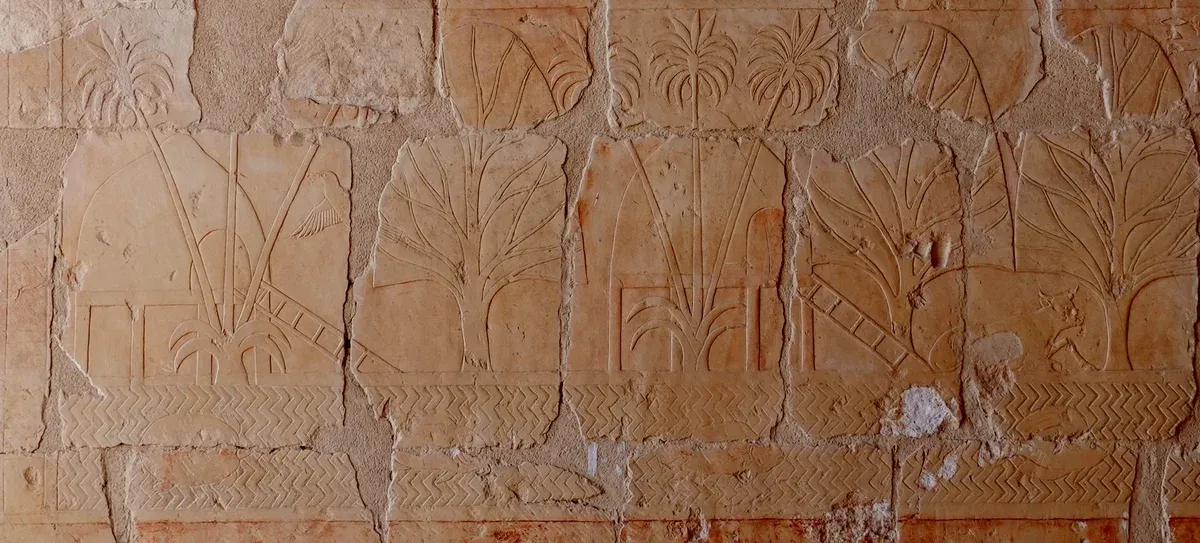
Carved incense trees from the Punt expedition on a wall of Hatshepsut's temple at Deir el-Bahari. Photo: Ismoon, CC BY-SA 4.0, via Wikimedia Commons
Quick answer Temple of Hatshepsut in brief
The Temple of Hatshepsut is a 273.5 metre long mortuary temple set against the cliffs at Deir el-Bahari on Luxor's west bank. Built for the female pharaoh Hatshepsut, it rises in three terraces connected by ramps. The foreign adult ticket is 440 EGP on the Ministry's temple page and 360 EGP on the Ministry's Deir el-Bahari site page, so the two official pages differ.
Key takeaways
- Ticket confusion is real: the Ministry prints 440 EGP on one page and 360 EGP on another. See the ticket details in Visiting the Temple.
- The middle terrace carries the Punt reliefs and Hatshepsut's divine birth scene. Details in The Three Terraces.
- The cheapest half day that stops here is West Bank Half Day with Lunch at $23. Compare all listings in the comparison table.
- The tombs nearby have their own tickets and rules. Start with Valley of the Kings tickets.
The Pharaoh Who Built It
Hatshepsut took the pharaoh's role around 1472 BC and raised a terraced temple at Deir el-Bahari. Her steward Senenmut claimed to be its chief architect.
From Regent to Pharaoh
Hatshepsut came to power as regent for Thutmose III, who inherited the throne at about age two. By Year 7 of his reign, around 1472 BC, she had taken the full pharaoh's role for herself. The temple at Deir el-Bahari was built between her seventh and twentieth regnal years, and its plan was revised repeatedly during construction.
The finished temple is 273.5 metres long. It was a working temple with five cult sites, for Amun, Hathor, Anubis, the sun and the royal mortuary cult, not simply a monument to one woman. About twenty years after her death, Thutmose III ordered her memory erased from the walls, a story told under the defacement below.
Senenmut, the Steward Behind the Design
The architect of the temple is not certain. Wikipedia notes that the design may have been the work of Senenmut or of the high priest Hapuseneb, but Senenmut himself claimed on his own monuments to be chief architect at Deir el-Bahri. He held the titles Steward of the God's Wife and Steward of the King's Daughter Neferure, and he built two unfinished tombs, TT71 and TT353.
Beside Hatshepsut's temple at Deir el-Bahari sits the older temple of Mentuhotep, built about 600 years before it.
The Three Terraces
The temple stacks three terraces against the cliff, each reached by a ramp rather than stairs. The reliefs on their porticos read like a stone magazine of Hatshepsut's reign.
The Lower Terrace
The lower terrace is 120 metres deep and 75 metres wide, with 22 columns in each portico. The lower terrace once held two persea trees and two T-shaped basins for papyrus and flowers. A one kilometre causeway, 37 metres wide, once linked a valley temple to the temple gate, with a barque station at its midpoint.
The reliefs here include a scene on the south portico showing two obelisks being shipped from Elephantine to Karnak.
The Middle Terrace and the Punt Reliefs
The middle terrace is 75 metres deep and 90 metres wide, and it holds the temple's most famous art. The southwest portico carries the reliefs of the expedition to the Land of Punt, sent in Year 9 with a fleet of five ships and led officially by Chancellor Nehsi. The carved scenes name the Puntite rulers as King Parahu and Queen Ati and record the cargo the fleet hauled home: gold, ivory, ebony, incense, aromatic resins, live animals, cosmetics, fragrant woods and myrrh trees.
Facing it on the northwest portico is the scene of Hatshepsut's divine birth, the oldest known wall scene of its type. Give this terrace the most time of the three.
The Upper Terrace and the Osiride Statues
The upper terrace has 26 columns, and each one is fronted by a 5.2 metre Osiride statue of Hatshepsut. Look at the crowns. The southern statues wear the Upper Egyptian crown and the northern ones the Lower Egyptian crown.
Visitors have had access to the festival courtyard and upper terrace since 2000, the solar cult court since 2015 and the sanctuary of Amun since 2017. Polish teams restored nine monumental statues from the upper portico facade.
The Hathor and Anubis Chapels
Two chapels sit at the ends of the middle terrace. The Hathor shrine at the south end is the larger of the two, with a portico of four Hathor-headed columns and two halls of 12 and 16 columns. Scratched-out feminine pronouns are common in this shrine.
The Anubis shrine at the north end is smaller, with a hall of 12 columns set in three rows of four. Its reliefs include a scene of Anubis escorting Hatshepsut. The temple had five cult sites, for Amun, Hathor, Anubis, the sun and the royal mortuary cult.
Temple of Hatshepsut Explained - Luxor
An explainer on the terraces, reliefs and history of Hatshepsut's temple at Deir el-Bahari. Third-party video by Manuel Bravo. This site did not shoot it and has no relationship with the creator.
Visiting the Temple
The practical facts before you go: the ticket, where the official price differs, the best time of day, and how the damage and restoration shaped what you see.
Ticket, Hours and Practical Details
The ticket figures below come from the Ministry of Tourism and Antiquities pages. Note the ticket conflict: the Ministry's own temple page and its Deir el-Bahari site page print different foreign adult prices, so budget for the higher one. Official prices are quoted in Egyptian pounds and never added to tour prices.
| Item | Detail |
|---|---|
| Foreign adult ticket | 440 EGP on the Ministry's temple page, 360 EGP on the Ministry's Deir el-Bahari site page |
| Foreign student ticket | 220 EGP on the temple page, 180 EGP on the Deir el-Bahari site page |
| Opening hours | Check the official site before you travel |
| Electric car | Whether a shuttle runs from the ticket area to the temple base is not confirmed here. Ask at the ticket office |
| Time needed | Allow time for three ramp climbs. The West Bank tours that stop here run from 4 hours to a full day |
| Best time | Early morning or late afternoon in summer. October to April is the temperate season |
Heat, Shade and the Temple's Damaged Story
The temple has three terraced levels with some trees, and the Tourist Checklist advises early morning or late afternoon in summer, with October to April the temperate season. Carry water and a hat.
The walls also carry damage with a story. In his forty-second regnal year, about twenty years after Hatshepsut's death, Thutmose III ordered her reign erased. The methods varied from scratching out feminine pronouns, common in the Hathor shrine and on the upper terrace, to chiselling away her image or replacing it with an offering table. The campaign was short and was abandoned when Amenhotep II took the throne. Akhenaten's agents later attacked images of Amun at the temple, and an earthquake in the ninth century BC caused further damage. On 17 November 1997 gunmen killed 62 people, 58 of them foreign tourists, at the temple.
The restoration has been a Polish-Egyptian project. The Polish Centre of Mediterranean Archaeology has restored the temple since 1961, with the mission founded by Kazimierz Michalowski and reconstruction directed by Zygmunt Wysocki from 1967 to 1988. Wikipedia dates the whole-temple work from 1967. The teams restored nine monumental statues from the upper portico facade and the first sandstone sphinx on the lower courtyard, and visitors have had access to the festival courtyard and upper terrace since 2000, the solar cult court since 2015 and the sanctuary of Amun since 2017.
If you are pairing this temple with the royal tombs across the hill, the Valley of the Kings tickets guide explains which tombs the standard ticket covers and what costs extra, and Tutankhamun's tomb has its own separate ticket.
Tours That Stop at Hatshepsut
Several bookable tours include the temple. Entry tickets are NOT included unless the listing says so, so read each line before you book.
Half-Day and Full-Day Options Compared
The figures come from each tour's own listing. The comparison table on the homepage puts every tour side by side, including the Luxor day trips from Hurghada that also stop at the temple. The table below covers the listings most focused on this temple.
| Tour | Price | Time at the temple | Entry tickets |
|---|---|---|---|
| West Bank Half Day with Lunch | $23 | not stated | Optional add-on, selected at booking |
| Private West Bank Half Day | $40 | not stated | Not included |
| Private West Bank, Kings and Queens | $89.24 | not stated | Admission included |
| Balloon Ride and Full-Day Sights | $160 | 15 minutes | Included |
What Each Tour Actually Includes
The $23 half day from Luxor covers the Valley of the Kings, Hatshepsut Temple and the Colossi of Memnon in 5 hours with lunch at a local restaurant, but entrance fees are an option you add at booking and cash is advised for tips or extra tomb entries. The $40 private half day runs 4 to 5 hours over the same three sites, yet excludes all fees and taxes, and a guide in a language other than English adds 5 dollars per person. The $89.24 private day is the one where admission to Hatshepsut Temple, both valleys, Deir el-Medina and Medinet Habu is included, over 8 hours.
The $160 package bundles a balloon flight with the Valley of the Kings, Hatshepsut Temple and Karnak, with entry fees included, but the temple stop is only 15 minutes and lunch is an optional 30-minute break at an extra fee. Pair the temple with the tombs using the Valley of the Kings map, and see Valley of the Queens and Medinet Habu for the other West Bank stops. For the temple details of Hatshepsut's own era, the Karnak Temple guide covers where her shipped obelisks ended up.
Sources: Ministry of Tourism and Antiquities, Deir el-Bahari, Wikipedia, Mortuary Temple of Hatshepsut, PCMA, The Tourist Checklist
FAQ
Was Hatshepsut buried in her mortuary temple?
The temple was a cult complex with five cult sites, including her royal mortuary cult. The sources used for this guide do not place her burial there. For the royal tombs, see the Valley of the Kings map guide.
What is Hatshepsut most known for?
She is known as the woman who took the full pharaoh's role around 1472 BC after serving as regent for the child Thutmose III, and for the temple at Deir el-Bahari with its Punt expedition reliefs and the oldest known divine birth scene. The mortuary temple is 273.5 metres long and built across three terraces, as described in The Three Terraces.
Is Hatshepsut temple worth visiting?
The reliefs alone justify it. The Punt scenes record a five-ship fleet carrying back gold, ivory, ebony, incense and myrrh trees, and the divine birth scene on the northwest portico is the oldest known of its type. Plan the visit with the Visiting the Temple details and book a stop through the Valley of the Kings tours homepage.
How much is the ticket for the Temple of Hatshepsut?
The Ministry's temple page prints 440 EGP for foreign adults and 220 EGP for students, while the Ministry's Deir el-Bahari site page prints 360 EGP and 180 EGP, so the official figures differ. See the full ticket table in Visiting the Temple, and read Valley of the Kings tickets for the tombs next door.
Who built the Temple of Hatshepsut?
The architect is uncertain. Wikipedia says the design may be the work of Senenmut or the high priest Hapuseneb, though Senenmut claimed the chief architect role at Deir el-Bahri on his own monuments and built two unfinished tombs, TT71 and TT353. The full story is in The Pharaoh Who Built It.
Why are some of Hatshepsut's images damaged?
Thutmose III ordered her reign erased in his forty-second regnal year, about twenty years after her death, chiselling her images or replacing them with offering tables before the campaign was abandoned under Amenhotep II. Akhenaten's agents later attacked images of Amun and a ninth century BC earthquake added damage. The Polish Centre of Mediterranean Archaeology has restored the temple since 1961, told in the defacement and restoration section.